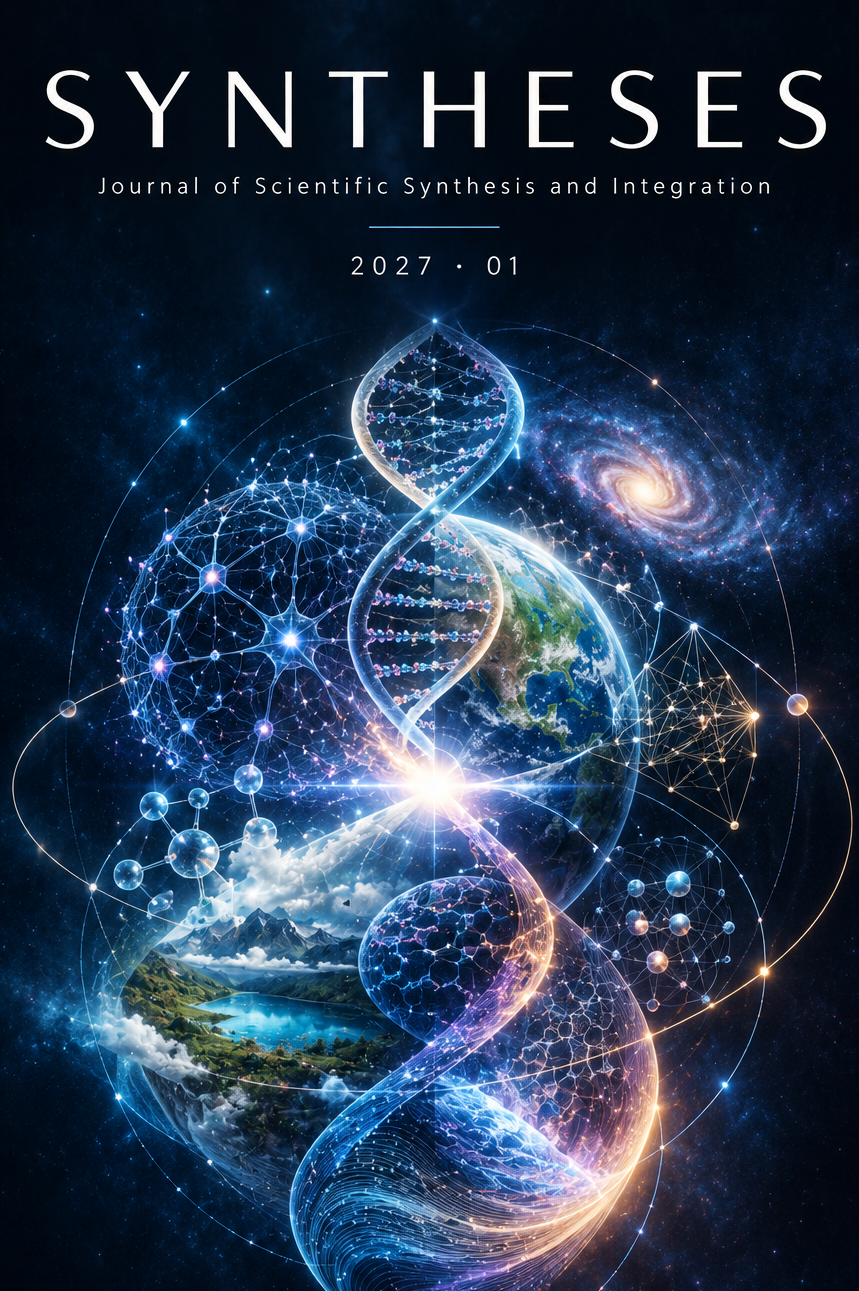
Synthesis as Scientific Imperative: Transcending Disciplinary Fragmentation in the Age of Complexity 15 1
Keywords:
Scientific synthesis, interdisciplinary integration, complexity science, unity of knowledge, multidisciplinary research, epistemological pluralismAbstract
This academic review provides a comprehensive examination of Syntheses – Journal of Scientific Synthesis and Integration, a newly established peer-reviewed open-access journal with a distinctive and ambitious mission: to serve as a platform for research in which synthesis, integration, and conceptual unification are not peripheral contributions but the very heart of scholarly inquiry. The review situates Syntheses within the broader intellectual history of scientific integration, tracing the tension between disciplinary specialization and the quest for unified understanding from the Enlightenment through the contemporary era of "big science" and complexity. It argues that Syntheses addresses a critical and increasingly urgent gap in the scholarly landscape by providing a dedicated venue for research that actively weaves together evidence, theories, and methodologies across the natural and life sciences—a necessity given the fragmented nature of modern science and the interconnected character of the most profound scientific questions. The review assesses the journal's philosophical foundations, its commitment to methodological and theoretical pluralism, its operational model, and its potential to foster genuine synthetic scholarship. Drawing on the work of philosophers of science (Kitcher, 2003; Cartwright, 1999), historians of science (Galison, 1997; Daston & Galison, 2007), and theorists of interdisciplinarity (Klein, 1990; Szostak, 2015), the review concludes that Syntheses occupies a uniquely vital niche, with the potential to catalyze a new era of integrative scientific inquiry that addresses the most pressing challenges of our time.
References
Bedau, M. A. (1997). Weak emergence. Philosophical Perspectives, 11, 375-399.
Cartwright, N. (1983). How the Laws of Physics Lie. Oxford University Press.
Cartwright, N. (1999). The Dappled World: A Study of the Boundaries of Science. Cambridge University Press.
d'Alembert, J. L. R. (1963). Preliminary Discourse to the Encyclopedia of Diderot. Bobbs-Merrill. (Original work published 1751)
Daston, L., & Galison, P. (2007). Objectivity. Zone Books.
Feyerabend, P. (1975). Against Method. New Left Books.
Galison, P. (1997). Image and Logic: A Material Culture of Microphysics. University of Chicago Press.
Gell-Mann, M. (1994). The Quark and the Jaguar: Adventures in the Simple and the Complex. W. H. Freeman.
Giere, R. N. (1999). Science Without Laws. University of Chicago Press.
Gould, S. J. (2003). The Hedgehog, the Fox, and the Magister's Pox. Harmony Books.
Hey, T., Tansley, S., & Tolle, K. (Eds.). (2009). The Fourth Paradigm: Data-Intensive Scientific Discovery. Microsoft Research.
Humphreys, P. (2004). Extending Ourselves: Computational Science, Empiricism, and Scientific Method. Oxford University Press.
Kant, I. (1998). Critique of Pure Reason. Cambridge University Press. (Original work published 1781)
Kim, J. (1999). Mind in a Physical World. MIT Press.
Kitcher, P. (2003). Science, Truth, and Democracy. Oxford University Press.
Klein, J. T. (1990). Interdisciplinarity: History, Theory, and Practice. Wayne State University Press.
Klein, J. T. (1996). Crossing Boundaries: Knowledge, Disciplinarities, and Interdisciplinarities. University Press of Virginia.
Meadows, D. H. (2008). Thinking in Systems: A Primer. Chelsea Green Publishing.
Mitchell, S. D. (2003). Biological Complexity and Integrative Pluralism. Cambridge University Press.
Mitchell, M. (2009). Complexity: A Guided Tour. Oxford University Press.
Morgan, M. S., & Morrison, M. (Eds.). (1999). Models as Mediators. Cambridge University Press.
Nagel, E. (1961). The Structure of Science. Harcourt, Brace & World.
Nowotny, H., Scott, P., & Gibbons, M. (2001). Re-Thinking Science: Knowledge and the Public in an Age of Uncertainty. Polity Press.
Stich, S. (1990). The Fragmentation of Reason. MIT Press.
Syntheses - Journal of Scientific Synthesis and Integration. (2026). Aims and Scope. AnKa Publisher. https://www.ankapublisher.com/index.php/Syntheses
Szostak, R. (2015). Introduction to Interdisciplinary Studies. Kendall Hunt.
Whewell, W. (1840). The Philosophy of the Inductive Sciences. John W. Parker.
Willinsky, J. (2006). The Access Principle: The Case for Open Access to Research and Scholarship. MIT Press.
Wilson, E. O. (1998). Consilience: The Unity of Knowledge. Knopf.
Downloads
Published
Issue
Section
License
Copyright (c) 2026 Editorial (Author)

This work is licensed under a Creative Commons Attribution-NonCommercial 4.0 International License.