Highlights
Current Issue
Vol. 1 (2027): Null Results Are Not Null
In science, the absence of an effect is often mistakenly equated with an absence of progress. The inaugural issue of Nullius in Verba (Issue 2027 01) challenges this publication bias by emphasizing that well-executed experiments yielding null or negative findings are essential components of scientific truth. Inspired by the landmark 2016 Nature Physics editorial "Nullius in verba", this issue reinforces a foundational principle: a null result is only "null" if we fail to recognize its informative value. Finding that a hypothesized effect is absent, smaller than anticipated, or statistically indistinguishable from background noise provides crucial empirical evidence. Taking the Royal Society’s motto literally—"Take nobody's word for it"—requires us to publish and evaluate evidence based on methodological rigor rather than the novel direction of the outcome.
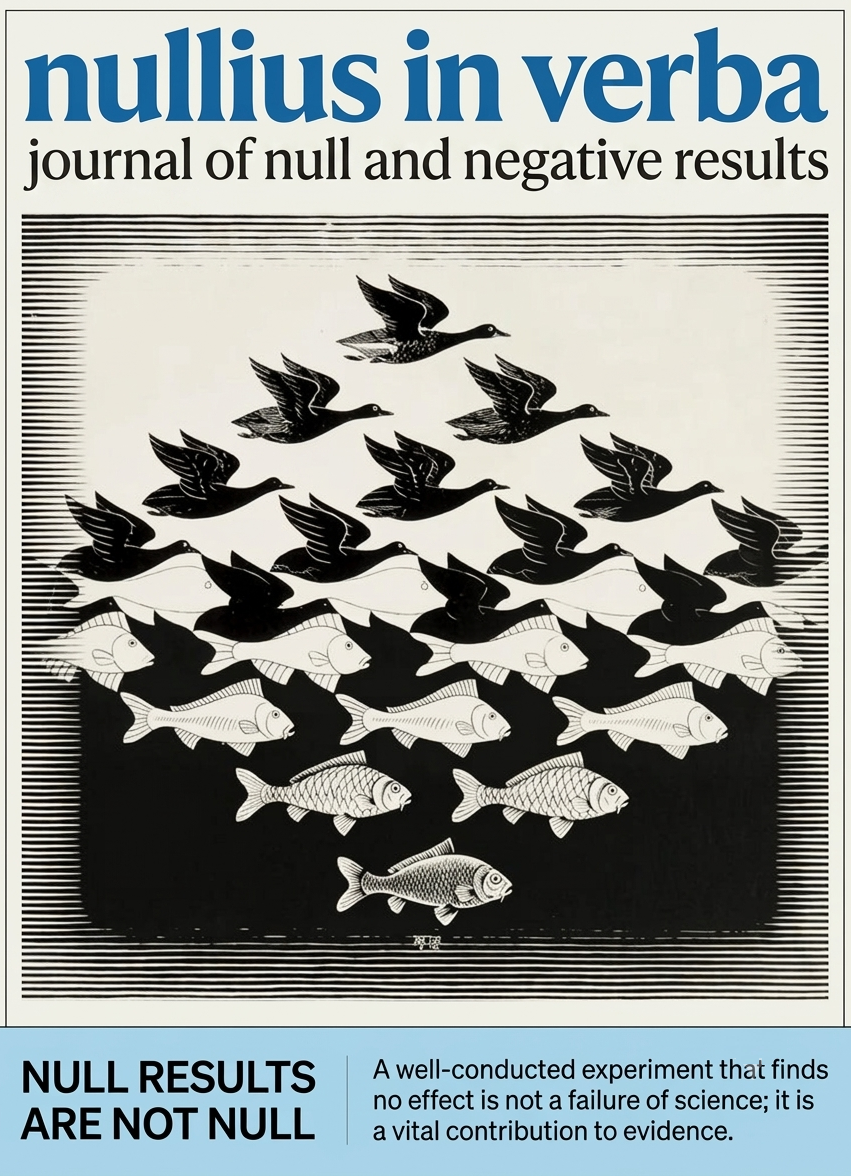
Cover: The cover features M.C. Escher’s iconic woodcut "Sky and Water I". Through its mastery of negative space (tessellation), the artwork demonstrates how the black birds and white fish mutually define one another. Without the negative space, the primary figures lose their form. In the same way, null and negative results form the indispensable backdrop that gives shape, validity, and context to all scientific discovery.
Published:
2026-09-25
Null Results Are Not "Null"
In 2016, Nature Physics published an editorial titled simply "Nullius in verba," which addressed the recurring appearance of "null results" in physics. The editorial made a point that lies at the heart of this journal: a null result is only "null" if you place no value in the information it provides. A well-conducted experiment that finds no effect is not a failure of science; it is a contribution to it. The information it yields — that a hypothesized effect is absent, or smaller than expected, or indistinguishable from noise — is exactly the kind of evidence that nullius in verba demands we take seriously.
Why Publish with NiV?
-
Dedicated venue — a journal whose sole purpose is negative, null, and failed results
-
Diamond Open Access — no fees for authors or readers
-
Open peer review — reviewer identities and reports published alongside the article
-
AI-assisted pre-check — 48-hour screening for plagiarism, statistics, and ethics
-
No Space Constraints, No Extra Space or Color Charges No restriction on the maximum length of the papers, number of figures or color
-
Registered Reports — in-principle acceptance before results exist
-
No "lack of interest" rejections — reviewers must justify rejection on methodological or ethical grounds
-
DOI and permanent archiving — every article is citable and preserved
-
CC BY 4.0 — authors retain copyright, readers may reuse freely
The name of this journal comes from the motto of the Royal Society, adopted soon after the Society's founding in 1660 by John Evelyn and other Fellows. Nullius in verba is Latin for "take nobody's word for it" or, more literally, "no one's words."
The Royal Society explains the motto as "an expression of the determination of Fellows to withstand the domination of authority and to verify all statements by an appeal to facts determined by experiment." It is a declaration of intellectual independence: no claim is accepted merely because an authority asserts it, and every statement must be tested against evidence.
The phrase itself is older than the Royal Society. It comes from Horace's Epistles (Book I, Epistle I) to his patron Maecenas, where the poet declares that he is not bound to swear by the words of any master:
Nullius addictus iurare in verba magistri,
quo me cumque rapit tempestas, deferor hospes."Not bound to swear by the words of a master; where the storm drives me, I turn in for shelter."