Diamond Open Access
Nullius in Verba (NiV) — Journal of Negative, Null and Failed Results is published under a Diamond Open Access model. This means that neither authors nor readers pay any fees. There are no submission charges, no article processing charges, no page or colour charges, and no subscription or paywall fees of any kind. Scientific knowledge produced through NiV is free to publish, free to read, and free to reuse.
Diamond Open Access is distinct from other open access models. In traditional subscription publishing, readers pay through libraries and institutions. In Gold Open Access, authors pay article processing charges. In Diamond Open Access, no one pays at the point of use. Instead, the costs of publication are supported by non-profit, community-driven, or institutional arrangements — such as universities, libraries, public funding agencies, learned societies, and consortia.
The choice of Diamond Open Access is not incidental to NiV's mission — it is integral to it. NiV exists to publish negative, null, and failed results, the very category of research that has historically been hardest to publish. If NiV charged authors, it would recreate the same exclusionary dynamic it was founded to correct. Researchers without dedicated funding would be unable to publish their negative results, and the file drawer problem would persist. Diamond Open Access removes this barrier entirely: any researcher, anywhere, can submit a negative result to NiV without financial consideration.
The Diamond Open Access Model: Principles, History, and Rationale
Nullius in Verba: Journal of Negative, Null and Failed Results (NiV) is published under a Diamond Open Access model. To explain what this means — and why it matters — it helps to place Diamond OA within the broader landscape of open access publishing, its historical roots, its global distribution, and its place in contemporary open science policy.
WHAT IS OPEN ACCESS?
Open access (OA) is a set of principles and practices through which research publications are delivered to readers free of access charges or other barriers. With open access strictly defined — or "libre" open access — barriers to copying and reuse are also reduced or removed through an open licence, such as Creative Commons.
The main focus of the open access movement has been peer-reviewed research literature, and more specifically academic journals. This focus has two structural reasons. First, the serials crisis: unlike newspapers, magazines, or fiction, academic journals cannot be readily substituted. An emergency-room physician treating a patient cannot replace the most recent paywalled review article with a 90-year-old copyright-expired article published before the relevant treatment existed. Second, authors are not paid: researchers who publish in academic journals are not paid for their articles, so when they move from paywalled to open access publishing — especially Diamond Open Access — they suffer no monetary loss.
Whereas non-open access journals cover costs through access tolls such as subscriptions, site licences, or pay-per-view charges, open access journals are characterised by funding models that do not require the reader to pay.
THE COLOUR SPECTRUM OF OPEN ACCESS
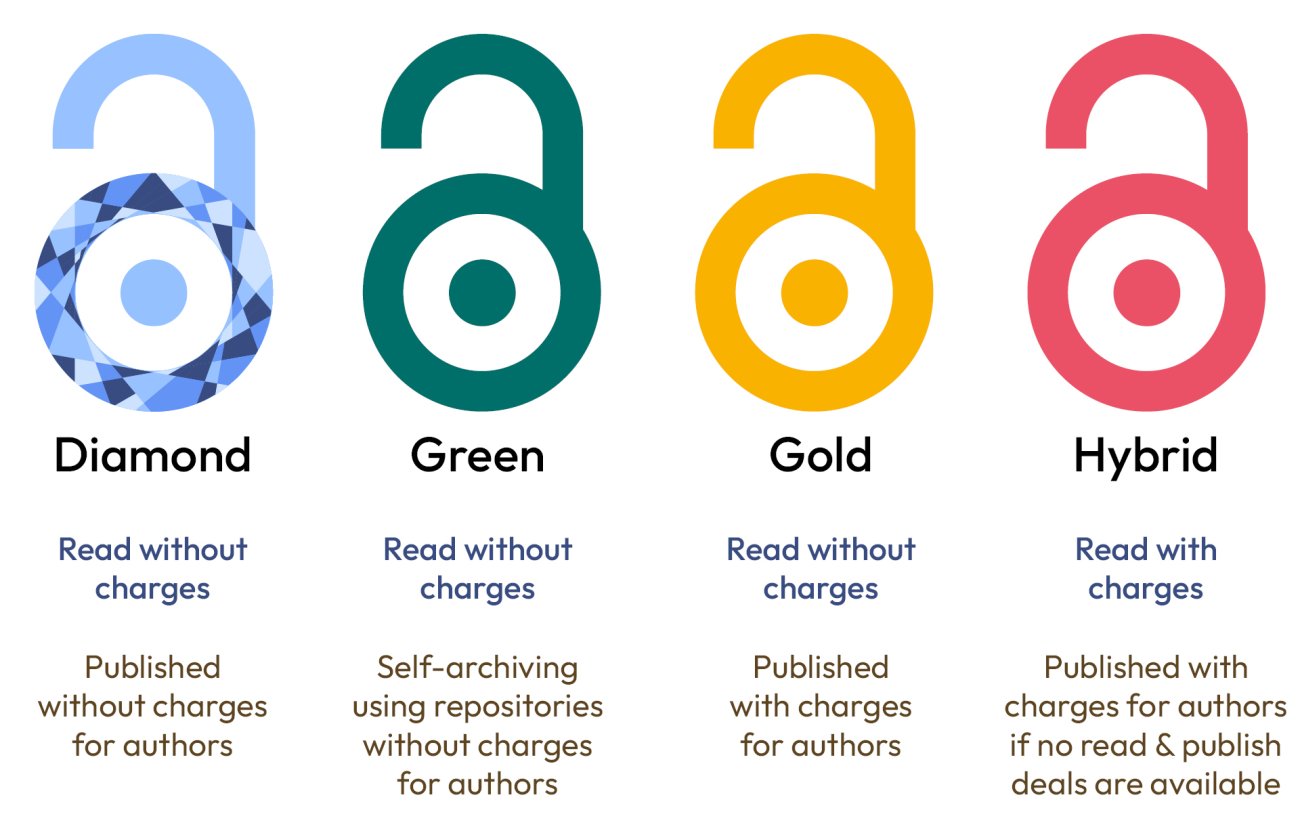
Different open access models are commonly described using a colour system. The most widely recognised are green, gold, and hybrid, with bronze, diamond/platinum, and black also in use.
Gold OA. In the gold OA model, the publisher makes all articles and related content freely available immediately on the journal's website, typically under a Creative Commons licence. Many gold OA publishers charge an article processing charge (APC), usually paid by the author's institution or research grant. The majority of gold OA journals charging APCs follow an "author-pays" model.
Green OA. In green OA, self-archiving by authors is permitted. Independently of publication, the author deposits a version of the work in a repository controlled by the author, their institution, or a central open repository, where it can be downloaded free of charge. Green OA is free of charge for the author.
Hybrid OA. Hybrid journals contain a mixture of open access and closed access articles. The publisher is partially funded by subscriptions and provides open access only for individual articles whose authors (or sponsors) pay a publication fee. Hybrid OA generally costs more than gold OA and can offer a lower quality of service. A particularly controversial practice is "double dipping", where both authors and subscribers are charged.
Bronze OA. Bronze OA articles are free to read on the publisher's page but lack a clearly identifiable licence. Such articles are typically not available for reuse.
Diamond/Platinum OA. Journals that publish open access without charging authors article processing charges are referred to as diamond or platinum OA. Alternative labels include non-commercial open access, cooperative open access, and, more recently, open access commons. Since they charge neither readers nor authors directly, such journals require funding from external sources — such as academic institutions, learned societies, philanthropists, government grants, or, in some cases, advertising. This is the model NiV follows. Diamond OA journals are available across most disciplines, are usually small, and are more likely to be multilingual. Over 350 platinum OA journals with impact factors exist across a wide variety of disciplines, giving most academics an option for OA with no APCs.
Black OA. Black OA refers to unauthorised digital copying of paywalled literature (e.g., Sci-Hub). It is not a publishing model and is not used by NiV.
GRATIS VS. LIBRE
Open access is also distinguished by gratis and libre. Gratis OA refers to free online access, to read, free of charge, without reuse rights. Libre OA also refers to free online access, plus additional reuse rights, typically via Creative Commons licences. NiV publishes libre OA under a CC BY 4.0 licence: free to read, copy, redistribute, and adapt with attribution.
HISTORICAL ROOTS OF DIAMOND MODELS
Until the Second World War, academic publishing was mostly characterised by a wide range of community-driven scholarly structures with little concern for profitability. Most journals of the 19th century and the first part of the 20th century were collective initiatives led by a scientific movement or institution, relying largely on informal community norms rather than commercial regulations. These historical practices have been described as a form of knowledge commons, or more specifically as a knowledge club — an intermediary status between a knowledge commons and a private company: managed by a community, but used mostly to the benefit of a selected set of authors and readers.
In Western Europe and North America, direct ownership of journals by academic communities and institutions started to wane in the 1950s. The expansion of scientific publishing in the context of big science led to a perceived "crisis" of the historical model of scientific periodicals. Between 1950 and 1980, the new model of large commercial publishers came to dominate numerous fields of scientific publishing in western countries. The small society presses, struggling to cope with growing scale, were supported and then largely supplanted by the "Big 5" commercial presses: Elsevier, Wiley, Springer, Taylor & Francis, and Sage.
This transformation had wide-ranging consequences for the way scientific journals were managed — not only economically but also editorially, with increased standardisation of publishing norms, peer-review processes, and copyrights. Yet it was neither global nor general, and communal forms of journal ownership and management remained significant in large geographic areas (like Latin America) and in several disciplines, especially in the humanities and the social sciences.
THE DEVELOPMENT OF GRASSROOTS OPEN ACCESS (1990–2010)
The open access movement emerged both as a consequence of the unprecedented access afforded by online publishing and as a reaction against the large corporate model that had come to dominate scientific publishing, and against the hyper-inflation of subscription prices.
The early pioneers of open access electronic publishing were non-commercial and community-driven initiatives that built on a trend of grassroots publishing innovation in the social sciences and the humanities. In the late 1980s and early 1990s, a host of new journal titles launched on listservs and, later, the Web — journals such as Postmodern Cultures, Surfaces, the Bryn Mawr Classical Review, and the Public-Access Computer Systems Review — all managed by scholars and library workers rather than publishing professionals.
Specialised free software for scientific publishing, such as Open Journal Systems, became available after 2000. This development entailed a significant expansion of non-commercial open access journals by facilitating the creation and administration of journal websites and the digital conversion of existing journals. Among the journals registered in the Directory of Open Access Journals (DOAJ) without an article processing charge, the number of annual creations went from 100 by the end of the 1990s to 800 around 2010.
FROM PLATINUM TO DIAMOND: NAMING THE MODEL
In the early debates over open access, the distinctions between commercial and non-commercial forms of scientific publishing seldom appeared. Open access publications were rather categorised into two editorial forms: open access articles made immediately available by the publisher, and pre-published articles hosted on an online archive. Starting in 2003, the ROMEO project devised a colour-code system to identify publishers' policies on open sharing, from "yellow" (pre-print only) to "green" (no restriction). In 2004, Harnad and colleagues repurposed this scheme into a binary scale: articles directly made available by the publisher belonged to "gold" open access, and online archives were defined as "green" open access. With this breakdown, there was no distinction between commercial and non-commercial publishers.
Tom Wilson introduced the expression "Platinum Open Access" in 2007 following a heated debate with Stevan Harnad and other open access activists. On his blog, Wilson defended the necessity of enlarging the classification of open access publishing forms and stressed the danger of conflating commercial and non-commercial open access journals. He wrote: "[The 'gold' and 'green' classification] is not really the whole story and is in danger of perpetuating the myth that the only form of open access publishing is that made available through the commercial publishers, by author charging. This is why I distinguish between open access through author charging, which is what the Gold Route is usually promoted as being, and the Platinum Route of open access publishing which is free, open access to the publications and no author charges. In other words, the Platinum Route is open at both ends of the process: submission and access, whereas the Gold Route is seen as open only at the access end."
The term "diamond open access" was coined later, in 2012, by Marie Farge, a French mathematician and physicist and open access activist. Farge was involved in the Cost of Knowledge campaign led by Timothy Gowers against the excessive cost of scientific publishing. The reference to "diamond" was a hyperbolic pun on the "gold" metaphor, aiming to suggest that non-commercial/free models were ultimately the best. Farge wrote: "I have proposed to call this third way 'Diamond OA' by outbidding the 'Gold OA' terminology chosen by the publishers."
The Forum of Mathematics, an open access journal co-created by Timothy Gowers, was the first publication to explicitly claim to be a diamond journal.
DEFINING THE DIAMOND MODEL (2012–PRESENT)
In 2013, Fuchs and Sandoval published one of the first systematic definitions of diamond open access: "Diamond open access Model, not-for-profit, non-commercial organizations, associations or networks publish material that is made available online in digital format, is free of charge for readers and authors and does not allow commercial and for-profit re-use."
This definition is associated with a controversial stance against the leading definition of gold open access: Fuchs and Sandoval argued for differentiating the concept of Gold Open Access Publishing because Suber and others mesh together qualitatively different models — for-profit and not-for-profit — into the same category, whereas others, especially policy makers, simply forget or exclude not-for-profit models that do not use author fees or reader fees.
Since 2013, the theoretical literature on the diamond model has been increasingly influenced by institutional analysis of the commons. Consequently, the "Open access commons" has recently emerged as an alternative label, although the term is used less as a descriptor and more as a programmatic ideal for the future of non-commercial open access.
HOW LARGE IS DIAMOND OA?
Analysis of the diamond model has been significantly deepened by large-scale empirical studies such as the OA Cooperative Study (2016) by the Public Knowledge Project and the OA Diamond Study (2021) by cOAlition S. The 2021 study found:
-
The number of Diamond OA journals is very large (more than 29,000), but only about a third are registered in DOAJ, and only about 5% are indexed in either Scopus or Web of Science.
-
Over half of these Diamond OA journals publish 25 or fewer articles per year.
-
Between 2017 and 2019, paid-access journals published about 80% of all articles, paid-OA journals about 11%, and Diamond OA journals about 9%.
-
The share of Diamond OA publications among all OA journal articles peaked in 2018 and has been declining since.
-
Only 4.3% of Diamond OA journals are fully compliant with all Plan S criteria.
-
Only 55% of Diamond OA journals provide DOI numbers for their articles.
-
Only 25% provide their content as XML or HTML (in addition to PDF).
-
About half provide download statistics for their content.
-
Two-thirds use double-blind peer review — higher than subscription journals, which prefer single-blind peer review.
-
25% operated at a loss, and just over 40% reported breaking even.
-
70% declared operating costs below $/€10,000 per year.
-
The most challenging area is indexing and content visibility in the main research databases.
In 2021, it was estimated that between 17,000 and 29,000 scientific journals rely on a diamond open access model. They make up 73% of the journals registered in the Directory of Open Access Journals and 44% of the articles, as their mean output is smaller than commercial journals.
GLOBAL DISTRIBUTION
The majority of diamond open access journals are published in Europe (around 45%) and Latin America (around 25%). In relative terms, the diamond model is especially prevalent in Latin America (95% of open access journals registered in DOAJ) and Eastern Europe (81%).
In contrast with Western Europe and North America, the open access movement in Latin America was largely structured around publicly supported platforms like Redalyc, SciELO, and AmeliCA, rather than APC-based publishers. In Latin America, "publishing" is conceived as acts of "making public", of "sharing", rather than the activity of a profit-driven publishing industry. Latin American academic journals are led, owned, and financed by academic institutions; it is uncommon to outsource editorial processes.
The OA Diamond Study attributes these differences to the absence of large, privately owned publishers in the region: most major commercial publishers are based in Western Europe or the US/Canada, which explains some of the relative dominance of the APC model in those regions.
Diamond open access journals are also more likely to be multilingual (38%): while English is the most common language, Spanish, Portuguese, and French play a much more important role for OA diamond journals than for APC-based ones.
DISCIPLINES
While diamond OA journals are available for most disciplines, they are more prevalent in the humanities and social sciences. Among journals registered in DOAJ, humanities and social science publications make up 60% of diamond open access journals and only 23.9% of APC-based journals. This distribution may be due to the differentiated evolution of scientific publishing during the 20th century: small HSS journals are often owned by universities and societies, who often prefer OA diamond models, while many big science and medicine journals are owned by commercial publishers, more inclined to use APC models.
However, the diamond model is still present in many disciplines, with 22.2% of diamond journals in STEM and 17.1% in Medicine. Medical diamond journals are often embedded in local communities, especially in non-western countries.
ORGANISATION AND ECONOMICS
The OA Diamond Study introduced a taxonomy of six types of diamond OA journals based largely on their ownership status: institutional journals, learned-society journals, volunteer-run journals, publisher journals, platform journals, and large journals.
Most diamond open access journals are managed by academic institutions, communities, or platforms. The majority (42%) are owned by universities. The main alternatives are learned societies (14%) and, to a lesser extent, government agencies, university presses, and individuals. This integration ensures the autonomy of the journals: they are inherently independent from commercial publishers as they are not created by them and do not rely on them at the management level.
The main sources of support for diamond OA journals are non-monetary: in-kind support from research institutions (such as hosting and software maintenance, or copy-editing services) and voluntary contributions. Grant funding is significantly less mentioned in surveys, possibly because it does not always ensure a regular source of support.
Since the 1990s, shared platforms have become important intermediary actors for diamond journals, especially in Latin America (Redalyc, AmeliCA, SciELO, Ariadna Ediciones) and some European countries such as France (OpenEdition Journals), the Netherlands, Finland, Croatia, and Denmark (all via PKP's Open Journal Systems).
Operating costs of diamond journals are low: half of the 1,600 journals surveyed by the OA Diamond Study had costs below $/€1,000 per year. The median cost per article is around $200 — significantly lower than standard APCs for commercial open access journals. These low costs are accounted for by institutional support, limited expenses, and reliance on volunteer work: 60% of the journals surveyed were at least partly run by volunteers.
The governance models of diamond journals also have an impact on their economic models. Journals embedded in academic institutions are more likely to benefit from direct funding or support, whereas journals owned by learned societies rely significantly more on membership fees. Unlike APC-funded journals, research funding organisations tend not to support diamond OA journals, though there are proposals for new direct funding mechanisms.
PRESERVATION AND RECOGNITION
Long-term preservation is essential for all scholarly publications. Results from a survey presented in the OA Diamond Journals Study indicate that 57% of diamond OA journals have no preservation policy. While libraries have an incentive to preserve articles published by subscription-based journals to ensure their investment is not lost, there is no similar motivation for free online content.
Efforts are underway to solve this issue, such as Project JASPER (an ongoing project of the Directory of Open Access Journals), CLOCKSS, the Internet Archive, the KEEPERS Registry, and PKP-PN, as well as the automated preservation of published articles in LOCKSS when Open Journal Systems (OJS) is used.
While diamond open access journals make up a large share of all open access publications, they have long been overlooked by scientific funding mechanisms. The launch of the cOAlition S initiative in 2018 made the recognition of diamond journals more pressing. Support for open access publishing would now be conditioned on adherence to a series of editorial and economic standards which some diamond journals may struggle to conform to, given their limited means.
In 2020 and 2021, the institutional recognition of the diamond model progressed significantly with unprecedented commitments from national and international organisations. The 2021 UNESCO Recommendation for Open Science calls for "supporting not-for-profit, academic and scientific community-driven publishing models as a common good". The second French Plan for Open Science encouraged a "diversification of economic models" that highlights the diamond model as enabling "a transition from subscription towards open access with no publishing fees". In March 2022, an Action Plan for Diamond Open Access was published with the support of cOAlition S, Science Europe, OPERAS, and the French National Research Agency, aiming to "expand a sustainable, community-driven Diamond scholarly communication ecosystem". In 2024, the Toluca-Cape Town Declaration on Diamond Open Access declared that "scholarly knowledge is a public good" and that "diamond open access is driven by social justice, equity and inclusivity".
WHY DIAMOND OA FOR NIV?
The choice of Diamond Open Access is integral to NiV's mission, not incidental to it.
Aligning Model with Mission. NiV exists to publish negative, null, and failed results — the category of research that has historically been hardest to publish. If NiV charged APCs, it would recreate the same exclusionary dynamic it was founded to correct. Researchers without dedicated funding would be unable to publish their negative results, and the file drawer problem would persist. Diamond Open Access removes this barrier entirely: any researcher, anywhere, can submit a negative result to NiV without financial consideration.
Equity and Inclusion. Publication bias is not only a statistical phenomenon; it is also an equity phenomenon. Researchers in underfunded institutions, early-career researchers, and scholars in the Global South are disproportionately affected by APC-based models. The switch from pay-to-read to pay-to-publish has left essentially the same people behind. The inherent bias of APC-based OA publishing perpetuates inequality through the "Matthew effect" — the rich get richer, and the poor get poorer. Diamond Open Access ensures that the ability to publish negative results is not contingent on the ability to pay.
Community Ownership. Diamond Open Access is typically associated with community-owned, non-profit, and scholar-led publishing. NiV is committed to this ethos: the journal is governed by its editorial board and its scholarly community, not by a profit motive.
Alignment with Open Science Mandates. Major funders and policy frameworks — including Plan S, the UNESCO Open Science Recommendation, the Action Plan for Diamond Open Access, and the Toluca-Cape Town Declaration — increasingly recognise Diamond Open Access as a preferred model.
HOW NIV IS FUNDED
NiV does not charge authors or readers. Its costs are covered through a combination of sources. The primary support comes from AnKa Publisher, which provides hosting, DOI registration, ISSN maintenance, technical support, and editorial coordination. Voluntary editorial labour is provided by editors, reviewers, and board members. Supplementary support is accepted from institutions, libraries, consortia, funders, and donors where consistent with mission and independence. Public funding, where available, may come from grants from funding agencies and open-science programmes. This diversified, non-extractive funding model keeps NiV free at the point of use and independent in its editorial decisions.
WHAT DIAMOND OA MEANS FOR AUTHORS
There is no submission fee. There is no article processing charge. There are no page or colour charges. There is no paywall on published work. Authors retain copyright; articles are published under CC BY 4.0. Articles are permanently archived via repositories and archiving partners. Open access articles are read and cited more than paywalled ones, so authors reach a wider readership.
WHAT DIAMOND OA MEANS FOR READERS
There is immediate access — no subscription, login, or paywall. Unrestricted reuse is permitted under CC BY 4.0, which allows copying, redistribution, and adaptation with attribution. There is no institutional dependency — access does not depend on library budget. Global availability means researchers, clinicians, policymakers, students, and the public read on equal terms.
OPEN ACCESS IN CONTEXT — EXTENT AND GROWTH
Open access has grown substantially over the past two decades. In 2010, roughly 20% of peer-reviewed articles published in 2008 were openly accessible. By 2013, a European Commission study found that 50% of a random sample of 2011 Scopus-indexed articles were freely accessible by the end of 2012. In 2018, over 700,000 articles were published in gold open access worldwide, of which 42% were in journals with no author-paid fees. As of August 2024, 46.2% of works indexed in Scopus and published in 2023 had some form of open access.
Diamond OA is a substantial part of this landscape. According to the Directory of Open Access Journals (DOAJ), approximately 10,000 journals without APC are listed, and Diamond OA journals constitute a majority of open access journals worldwide.
OPEN ACCESS AND PEER REVIEW
The rise of OA publishing has given rise to experimentation in peer review — including posting results to preprint servers, preregistration of studies, open publishing of peer reviews, open publishing of datasets and analysis code, and other open science practices.
NiV contributes to this experimentation through open peer review (reviewer identities and reports published alongside the article), AI-assisted pre-check (48-hour screening for plagiarism, statistics, and ethics), Registered Reports (in-principle acceptance before results exist), and post-publication community review (90-day open comment period).
The rise of OA mega-journals has also made it viable for peer review to focus solely on methodology and results interpretation, whilst ignoring novelty — an approach NiV adopts by design.
OPEN ACCESS AND RESEARCH IMPACT
Open access articles are generally viewed and downloaded more often than paywalled articles, and readership continues for longer. Readership is especially higher in demographics that typically lack subscription access — including medical practitioners, patient groups, policymakers, non-profit workers, industry researchers, and independent researchers.
Open access articles are typically cited more often than equivalent subscription articles, with a measured citation advantage varying between 1.3-fold to 6-fold depending on discipline. OA articles also tend to receive more diverse citations — across institutions, countries, and research fields.
For NiV, these effects matter doubly: negative and null results are already underrepresented in the literature, and open access ensures that those that are published reach the widest possible audience.
SUSTAINABILITY AND GOVERNANCE
A common question about Diamond OA is: how is it sustainable? The answer lies in several factors. Lean infrastructure — open-source publishing software and shared infrastructure — keeps technical costs low. Voluntary academic labour means editors and reviewers contribute as part of their professional service. Diversified support means no single funder is essential. Transparent governance means annual reports on income, expenditure, and editorial decisions. Alignment with global policy means that as funders mandate Diamond OA, NiV is positioned to benefit.
Diamond OA journals use a variety of business models, including subsidies, advertising, membership dues, endowments, and volunteer labour. Subsidising sources range from universities, libraries, and museums to foundations, societies, and government agencies. NiV's model combines publisher infrastructure (AnKa Publisher) with supplementary support.
OPEN ACCESS AND INEQUALITY
Open access is not automatically equitable. Studies have found that gender inequality persists in publishing; OA may improve visibility for female researchers, but without deliberate support may also exacerbate inequality. High-income–low-income country inequality also persists: most OA articles are written by authors in high-income countries, and authors in low-income countries remain underrepresented in publishing.
Diamond OA directly addresses the second dimension by removing APC barriers. NiV is committed to monitoring and addressing both dimensions in its own editorial practice.
PREDATORY PUBLISHING AND QUALITY ASSURANCE
The rise of predatory publishers — entities that prioritise self-interest at the expense of scholarship, with false or misleading information and lax peer review — has damaged the reputation of OA publishing as a whole. NiV guards against this through COPE membership and compliance, open peer review (transparency as a quality signal), AI-assisted pre-check (screening for plagiarism and integrity), DOAJ, OASPA, and SciELO alignment (adherence to standardised conditions), and transparent governance (annual reporting).
COMMITMENT STATEMENT
Nullius in Verba is committed to Diamond Open Access as a matter of principle. We believe that the scientific record must be complete, equitable, and freely accessible. No author should be excluded from publishing negative, null, or failed results because of financial constraints. No reader should be excluded from learning from those results because of a paywall. Diamond Open Access is not a compromise; it is the model that best serves science and society.
Nullius in Verba: Journal of Negative, Null and Failed Results
Published by AnKa Publisher